

Frameworks
Overview
Health & Arts Community Collaboratory employs a blended framework of arts-integrated research and teaching to enrich professional healthcare education and enhance public health discourse. The framework has three components: PhotoVoice, Curation, and Engagement.
Research and teaching go hand-in-hand.

PhotoVoice
Phase 1
PhotoVoice is an approach to creative inquiry that combines photography with storytelling. It seeks to empower individuals and communities to document their lived experiences and advocate for change by placing cameras and narratives directly into the hands of those whose experiences are being documented. PhotoVoice shifts who gets to tell the story and the knowledge that enters the public discourse.
In phase 1, HACC faculty teach students to apply PhotoVoice to learning about factors affecting wellbeing, including health access and outcomes for different populations. Students listen and observe in community environments, create photographs, and write personal reflections on what they feel it means to be well in that context.

Curation
Phase 2
Curation is the careful process of selecting, organizing, interpreting, and presenting objects, images, or ideas to produce a physical or virtual exhibition. In designing exhibitions, HACC includes multiple voices and perspectives.
In phase 2, HACC faculty teach students curation using images and stories from phase 1. Students select and arrange the artworks thematically. They write text that communicates key ideas in the exhibition. They also design activities that offer audiences the opportunity to interact with and add their voices to the exhibition. What results is a cohesive, multisensory, and hopefully moving presentation of what it means to be well.
Engagement
Phase 3
Community engagement is the process of building meaningful reciprocal relationships and collaborations between institutions and their communities. It actively involves community members in decision-making, planning, and implementation of programs. The goal is to bring people together to foster civic dialogue and social connections.
In phase 3, HACC conducts community engagement through pop-up exhibitions, interactive events, and virtual tours that are free and open to the public. Each addresses issues affecting community health and well-being.
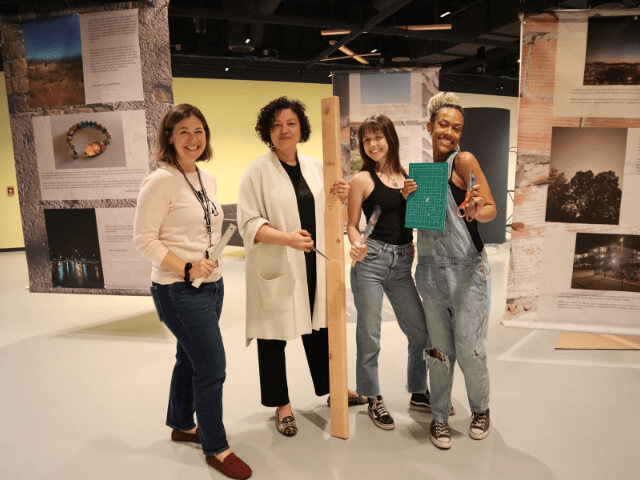
UA Student Preparators Chloe Riley and Melanie Richardson install the pop-up exhibition at the Center for Creative Photography.

Community participants engage with activities at the Center for Creative Photography during the University of Arizona Museum Day on March 29, 2025.
Courses
NURS 250: Health Equity: Connection, Community, & Healing in Urgent Times (College of Nursing)
This course addressed the most pressing issues challenging people’s health. Students learned to critically analyze health inequity problems from a multifaceted approach and engage in experiential service-learning projects within the community while developing skills to build connections using collective action to heal our communities.
PhotoVoice showcases the work that students created collaboratively, telling a story of the challenges and possible solutions that impact our local community regarding health equity.
Images paired with personal narratives can be catalysts for profound community transformation.
Nursing 250 Catalogs
ARE 633: Recent Issues and Research in Art and Visual Culture Education (School of Art, Arizona Arts)
Students in ARE 633: Recent Issues and Research in Art and Visual Culture Education, students focused on sensory and walking methodologies in class activities and experiential learning opportunities with nursing students. They focused on how these sensory experiences could be shared through artmaking and photography.

Students collected responses from participants about engaging with senses at the Center for Creative Photography pop-up exhibition.
These aren’t just photographs; they’re catalysts for policy change, community building, and social justice that prove everyone has wisdom worth sharing and stories that can transform our understanding of complex social issues.
ARE 525: Theory and Practice in Art Museum Education (School of Art, Arizona Arts)
Graduate students in ARE 525: Theory and Practice in Art Museum Education worked with the Center for Creative Photography to design components of the exhibition. The students looked at hundreds of photographs and narratives by nursing students to generate the themes Care, Consciousness, and Community. They also designed participatory components based on these themes:
Care
Care invited visitors to create zines, or small booklets, to share personal stories of health.
Consciousness
Consciousness asked visitors to create or add to magnetic poetry.
Community
Community asked visitors to share recipes and consider how food served to connect people through culture and heritage.

Graduate students select photographs and generate themes for the Center for Creative Photography pop-up exhibition.
These activities invited visitors to add their voices to the exhibition and were used to measure the impact of the exhibition. The exhibition also included videos, a virtual reality component, and Instagram feed that incorporated voices into the exhibition ranging from Tucson communities to international responses. In other pop-up exhibitions, visitors were asked to share their experiences through written responses to guiding questions for each theme.